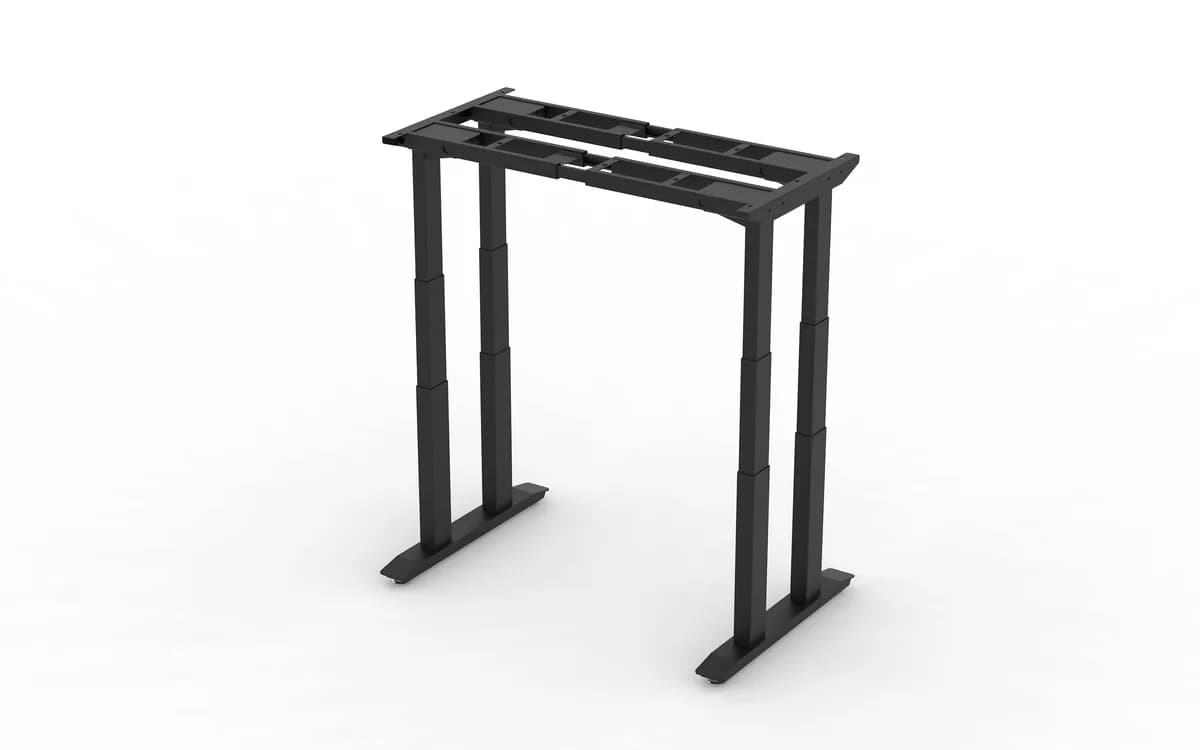
Deskhaus Peak Pro
The Peak Pro is the Apex Pro's three-stage sibling: same four independent motors, same 600 lb rating, same twenty-year warranty, but 25.5 inches of travel that tops out at 51.1 — high enough for someone around 6 ft 6 in to stand at properly. It spans tops up to 80 inches wide, and instead of crossbars it uses support wedges under the surface to take the flex out of a long span, which keeps the floor clear. The trade against the Apex is at the bottom: the three-stage columns start at 25.6 inches rather than 22.5. That is a real loss for shorter users and the reason the cheaper Apex remains the better desk for a lot of people. Think of the Peak as the tall person's version, not the upgraded one.
Who this desk fits
estimated, not measured
Reaching 25.6″ at the bottom and 51.1″ at the top, this desk can hit both a sitting and a standing elbow height for people roughly 5′4″ to 6′10″ tall.
How the height is quoted: Work-surface height with a 1-inch top, as Deskhaus quotes it ("Height ranges include a 1" work surface"); a 1.5-inch slab adds another half inch at each end. A separate 3-Stage Low frame runs 23–43.4 in.
Enter your height — 5'11", 71 or 180cm all work.
What ~$725 buys: Bare four-leg three-stage frame; tops are separate.
Specifications
At a glance
Features
- Three-stage columns to 51.1 in
- Four independent motors, 600 lb rated
- Takes tops from 43 to 80 in
- Support wedges instead of crossbars, keeping the floor clear
- 20-year frame and motor warranty
In its favour
- 51.1 inches suits users past 6 ft 5 in, which most frames cannot reach
- Handles tops to 80 inches with wedges rather than crossbars, so nothing blocks the floor
- 600 lb and four independent motors at a price below several two-leg desks
- Twenty years on the frame and motors
Against it
- The 25.6-inch minimum is three inches higher than the Apex Pro and too tall for shorter users
- Frame only, so a complete desk costs meaningfully more than the sticker
- Neither noise nor collision behaviour is published in detail
These points come from the published specification and the desk's design, not from owner reports — this model has not yet had enough owner discussion collected to draw on.
What owners say
Summarised from owner discussions and long-term write-ups, not from anything we tested ourselves.
The Peak Pro is the tall person's Deskhaus rather than the upgraded one, and getting that distinction right is the whole decision. It shares the four independent motors, the 600 lb rating and the twenty-year frame warranty with the Apex Pro, and adds a third leg stage that takes it to 51.1 inches — high enough for a standing user around 6 ft 6 in.
What it gives up is the bottom. Where the Apex starts at 22.5 inches, the Peak starts at 25.6, which by the seated-elbow estimate moves the shortest user it fits up by more than seven inches of stature. For a tall single user that is irrelevant; for a shared desk it is decisive, and the Apex is the better one.
Instead of crossbars it uses support wedges under the surface to take flex out of a long span, which keeps the floor genuinely clear — the usual four-leg compromise avoided.
What owners like
- Four independent motors and 600 lb at a price below several two-leg desks
- 51.1 inches at the top puts it in the small group that suits genuinely tall users
- Support wedges instead of crossbars keep the floor clear, which is the usual price of four-leg stability
- Twenty years on the frame and motors
Common complaints
- The 25.6-inch minimum is three inches higher than the Apex Pro's and too tall for shorter users
- Frame only, so a complete desk costs meaningfully more than the sticker
- Neither noise nor collision behaviour is published in any detail
- The same questions about how organically this brand is recommended apply here as to the rest of the range
Questions owners ask
Peak Pro or Apex Pro?
What holds an 80-inch top steady without a crossbar?
What does a complete desk cost?
Deskhaus Peak Pro, head-to-head
Desks people look at alongside it
More from Deskhaus →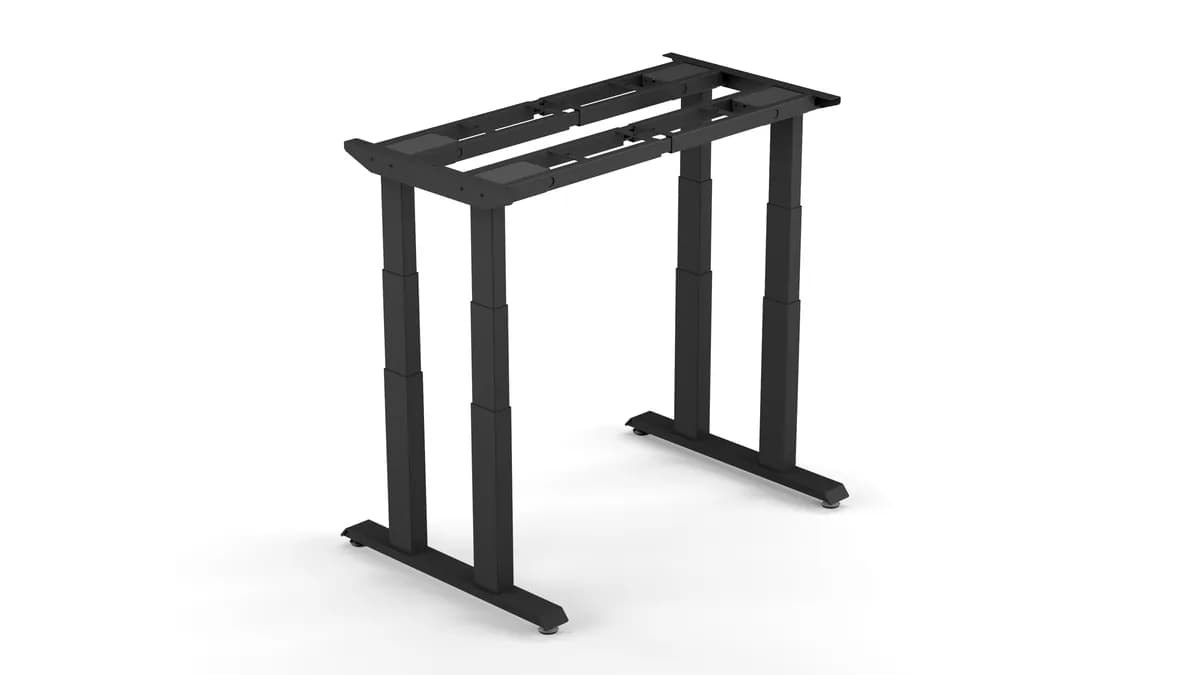
Deskhaus
Deskhaus Apex Pro
Four columns with an independent motor in each, a 600 lb rating and a twenty-year frame warranty — the Apex Pro is the frame people upgrade to after a two-leg desk disappoints them, and the accounts of that switch are strikingly consistent: the front-to-back movement simply stops. It is a base only, which suits its audience, because the people who buy it are usually pairing it with a slab they picked themselves. The paddle controller shows a live height readout, which turns out to matter when you have a drawer unit underneath and need to stop short of it. Two things to know before ordering. Deskhaus sells it as a preorder item, with the shorter and longer foot sizes on a 20-business-day lead time. And the brand's visibility in enthusiast discussion has drawn scepticism about how organic that enthusiasm is, which is worth knowing when you read glowing write-ups, this one included.
Fits 4′8″ to 6′6″ (est.)
Best for: Pairing with a heavy slab you chose yourself, especially if a previous two-leg desk wobbled.
Full spec sheet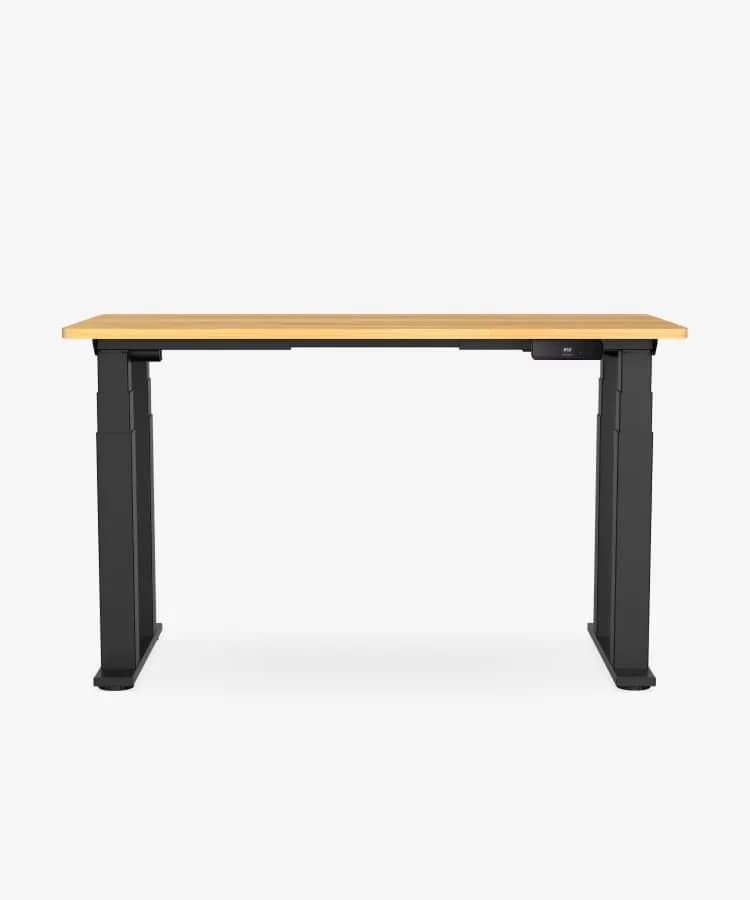
FlexiSpot
FlexiSpot E7 Plus
Four legs, a 440 lb lifting rating and a 52.6-inch working ceiling — the E7 Plus is FlexiSpot's answer to the wobble that dogs every two-leg desk, and owners who bought it specifically to stop their monitors shaking report exactly that outcome at both sitting and standing height. At about $700 with a laminate top it is the cheapest four-leg desk here, which is the whole argument for it, and it carries the same fifteen years on the frame and electronics as FlexiSpot's two-leg frames, with two on the laminate top. The 27-inch working minimum is high — this is not the desk for a short user — and four legs plus crossbars make for a long build and an awkward footprint around a drawer unit.
Fits 5′8″ to 7′1″ (est.)
Best for: Killing monitor shake on a budget, for anyone tall enough that a 27-inch working minimum is not a problem.
Full spec sheetThis is the answer to the complaint that follows every two-leg desk. Four columns, one motor each, a telescoping frame that spans 42 to 80 inches, and a 535 lb rating — the wobble that owners describe on wide two-leg tops at standing height largely stops being a topic. The height window is identical to the two-leg V3 because it uses the same three-segment columns, so nothing is given up on fit: it still reaches 22.6 inches for sitting and 48.7 for standing. What you pay is money, floor space and assembly time. Four legs mean more hardware than the two-leg desk, the extra legs take floor space a rolling drawer unit wants, and the entry price is $959 against $599. For an 80-inch top, a heavy tower on the frame or a three-monitor arm, that is the trade most owners who upgraded say they should have made first time.
Fits 4′9″ to 6′7″ (est.)
Best for: Wide tops, heavy multi-monitor rigs, or anyone who has already owned a two-leg desk and been annoyed by it.
Full spec sheet