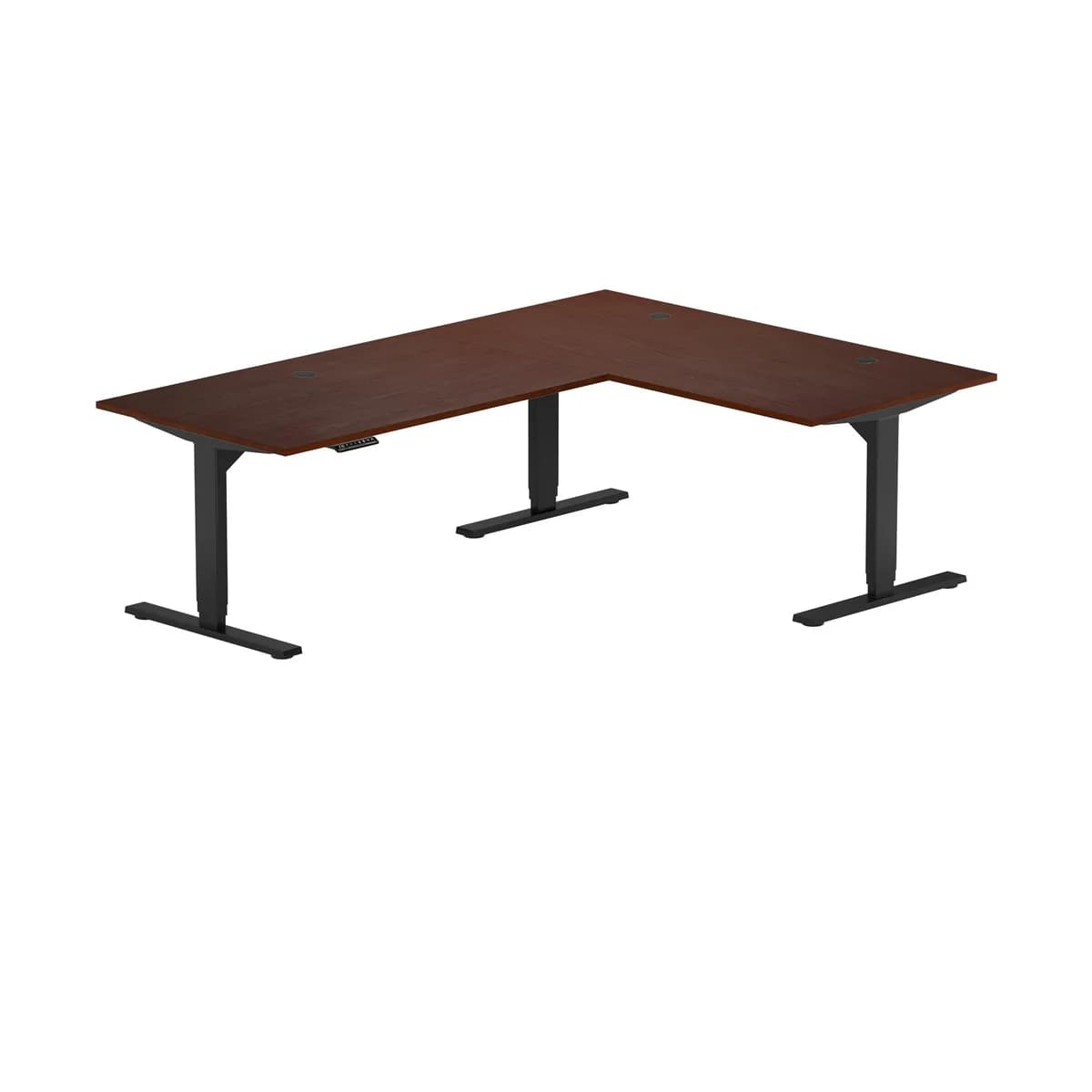
Progressive Desk Corner Ryzer
The corner version of the Solo Ryzer, on the same three-stage columns, so the work surface runs from about 24.6 to 50.1 inches — range that corner desks often give up. It comes in eighteen sizes, from a compact 60×48 to 90×72. Three motors drive the two wings together, it is rated for 330 lb across the surface, and it travels at 1.57 inches per second. As with the straight Ryzer, fifteen years covers the frame, the electronics and the tops. The honest caveats are a corner desk's usual ones: it is a two-person build, it is essentially immovable afterwards, and you should measure the room and the door before ordering rather than after. Progressive's pricing also moves enough with promotions that the figure here is a snapshot rather than a quote.
Who this desk fits
estimated, not measured
Reaching 24.6″ at the bottom and 50.1″ at the top, this desk can hit both a sitting and a standing elbow height for people roughly 5′2″ to 6′9″ tall.
How the height is quoted: Work-surface height with a 1-inch top: Progressive publishes 23.6–49.1 in as the frame height (23.5–49 in as installed). Both wings are driven together, so the figure applies across the corner.
Enter your height — 5'11", 71 or 180cm all work.
What ~$983 buys: Regular price of the complete desk in the small size group, which includes 60×60: from $982.97 ($786.38 on sale in October 2026); the largest sizes start at $1,185.97.
Specifications
At a glance
Features
- Three motors across both wings
- 24.6–50.1 in at the work surface
- 330 lb rated lift, 1.57 in/s
- Four presets
- 15-year warranty covering the desk and its tops
- Laminate, bamboo and solid-wood surfaces
In its favour
- Eighteen corner sizes, from a compact 60×48 to 90×72
- 330 lb spread over three legs handles a full corner setup
- Fifteen years on the frame, the electronics and the tops alike
- Bamboo and solid-wood corner surfaces are offered, not just laminate
Against it
- A two-person build and effectively immovable once assembled
- Pricing moves enough with promotions that any quoted figure is approximate
- No published noise figure
These points come from the published specification and the desk's design, not from owner reports — this model has not yet had enough owner discussion collected to draw on.
What owners say
Not enough owner discussion of the Progressive Desk Corner Ryzer has been collected to write this section honestly yet. Rather than fill it with paraphrased marketing copy, it stays empty until there is something real to report. The specifications above come from the manufacturer's own documentation.
Progressive Desk Corner Ryzer, head-to-head
Desks people look at alongside it
More from Progressive Desk →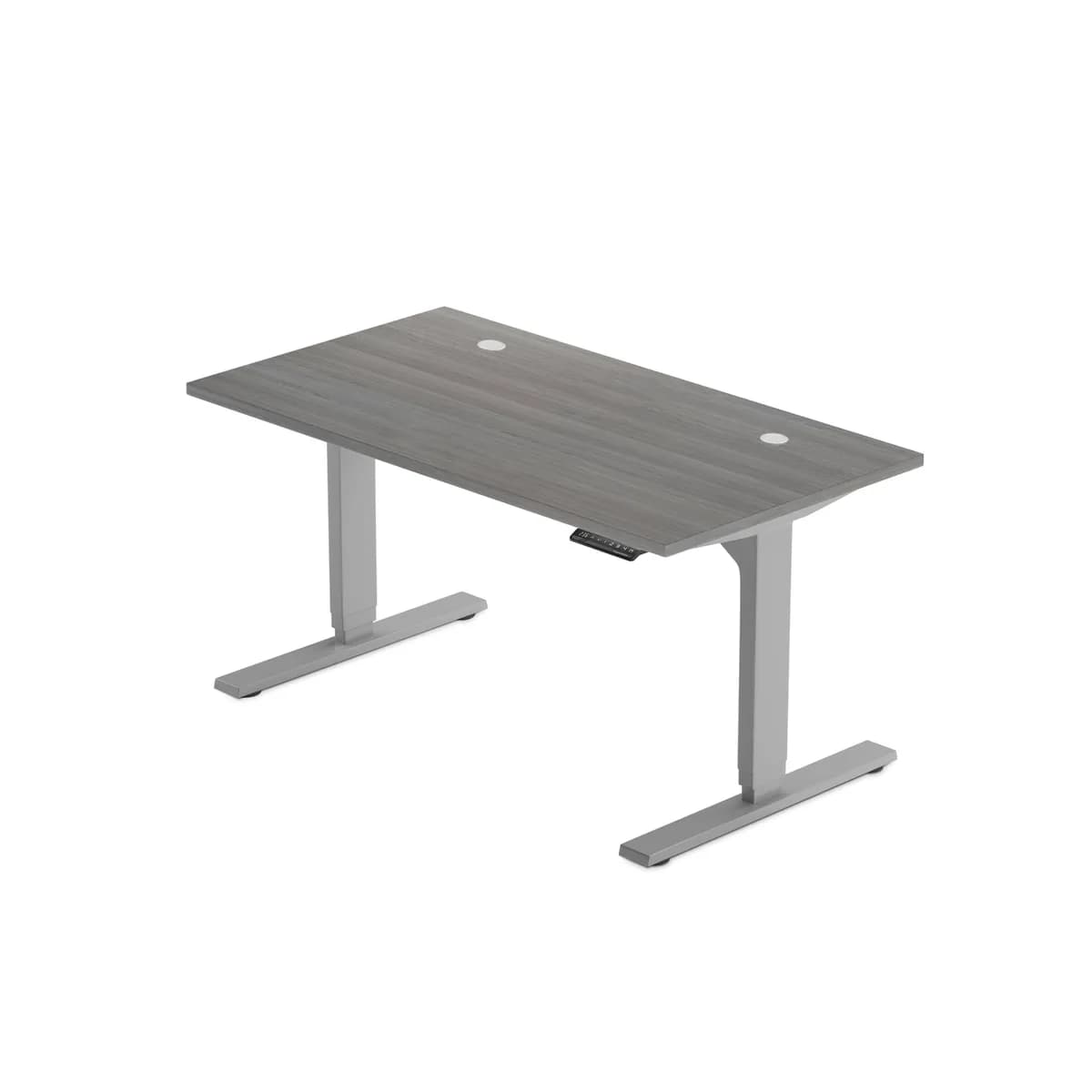
Progressive Desk
Progressive Desk Solo Ryzer
Progressive Desk builds around linear actuators from its own parent company rather than buying a generic control system, which is an unusual amount of vertical integration for a desk brand this size and shows up in a fifteen-year warranty that covers the frame, the electronics and the top alike. The Solo Ryzer is the straight two-leg desk: three-stage legs that put the work surface at about 24.6 to 50.1 inches with a 1-inch top, 270 lb, four presets, and a bamboo or solid-wood surface option at a price where laminate is normal. It is a Canadian brand with US distribution, so it turns up in cross-border comparisons more often than in domestic ones, and its prices move with promotions more than most. Nothing here is class-leading in isolation; the combination of three stages, a published 1.57 in/s and fifteen years of cover on everything at this price is the reason to look.
Fits 5′2″ to 6′9″ (est.)
Best for: A mid-budget build where a long warranty on the whole desk matters more than brand recognition.
Full spec sheet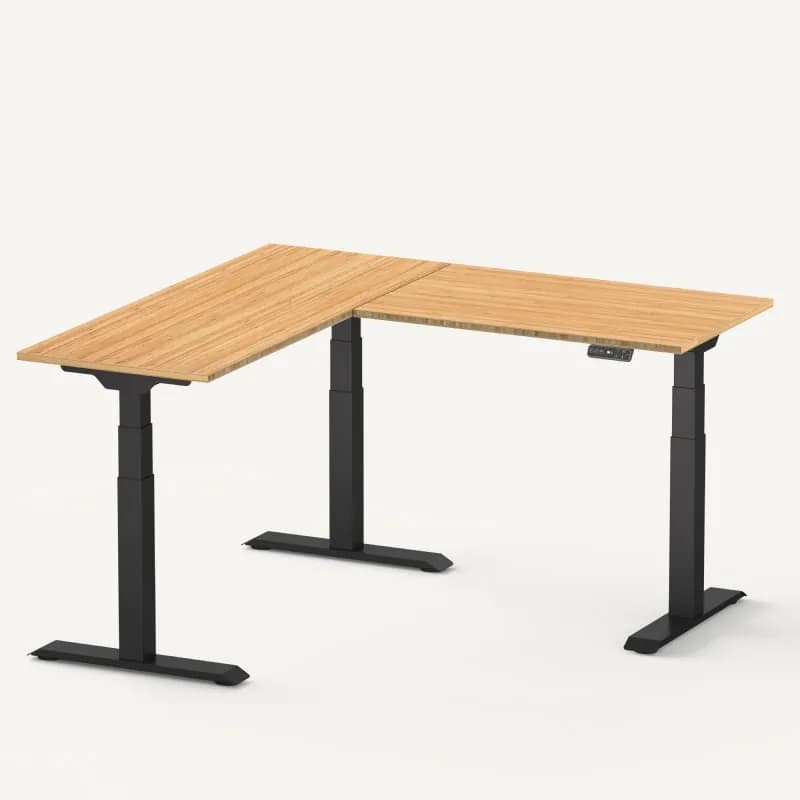
FlexiSpot
FlexiSpot E7L
Three legs, three motors, and a laminate corner top of 63 by 47 or 71 by 48 inches. The E7L is the cheap way into a powered L-desk, well under the other corner desks here, and the third leg is doing real work — the usual criticism of two-leg desks, that the far end of a wide top moves when you type, does not apply the same way when a leg sits under the corner. It travels at 1.5 inches per second, and its 330 lb static rating is already beyond what a corner setup normally carries. The catch is the family's: a 26-inch working minimum too high for short users. The warranty is not one — fifteen years on the frame and electronics, two on the laminate top. Sizing matters more than usual here — an L-desk is nearly impossible to move once built, so measure the room before, not after.
Fits 5′5″ to 7′0″ (est.)
Best for: A corner workspace on a budget, for someone tall enough to live with a 26-inch working minimum.
Full spec sheetA corner desk that actually raises and lowers is a different engineering problem from a straight one: three legs have to arrive at the same height at the same moment across two wings that are not the same length. UPLIFT's L-shaped V3 does it with three synchronised motors on the same three-stage columns as the straight desk, so the height window and the fit range are unchanged, and it is rated for 535 lb across the whole surface. It is the configuration to buy if you want a standing desk and a second work surface without the hard seam and mismatched heights of two desks pushed together. Budget properly: the $1,149 entry price is for UPLIFT's older V2 C-frame, the V3 frame described here is $100 more, and a realistic build is closer to $1,800.
Fits 4′9″ to 6′7″ (est.)
Best for: A corner office where one continuous surface beats two desks, and the budget stretches past most straight desks.
Full spec sheet