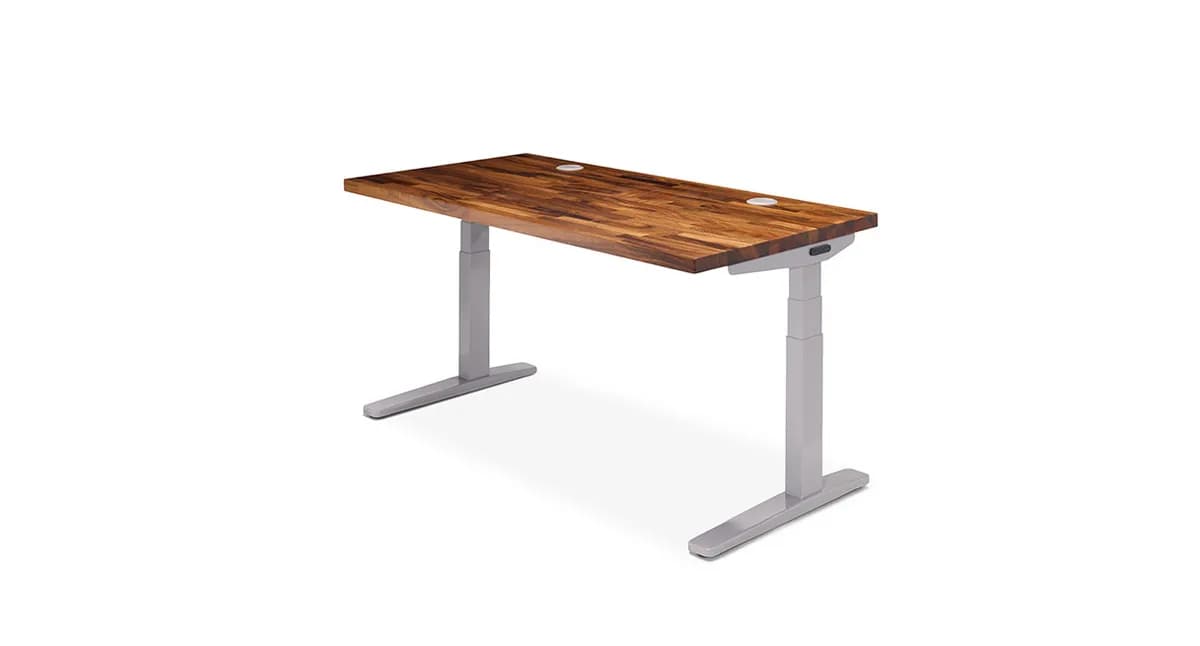
UPLIFT V3 Standing Desk
The V3 replaced the V2 that dominated home-office recommendations for five years, and the changes are the ones people had been asking for: the frame drops to 22.6 inches, travels at two inches a second rather than 1.57, and the assembly went from thirty-two screws to sixteen. It is a two-leg C-frame with three-segment columns, which is what lets it cover the full ANSI/BIFMA window from a genuinely low sitting height to 48.7 inches. There is no lower stretcher between the legs — the stiffness comes from a deep I-beam upper rail and a stability plate at the foot — so you keep clear floor for a chair mat and a tower, and you accept the trade every two-leg desk makes. The warranty covers the frame, motors, electronics and top together for fifteen years, and the configurator is the widest, from a $599 laminate build to reclaimed fir and pheasantwood slabs. Owner accounts of the two-leg frames are consistent on one point: front-to-back movement at full standing height is real, and the wider the top the more you feel it.
Who this desk fits
estimated, not measured
Reaching 22.6″ at the bottom and 48.7″ at the top, this desk can hit both a sitting and a standing elbow height for people roughly 4′9″ to 6′7″ tall.
How the height is quoted: Work-surface height with UPLIFT's standard 1-inch top. The figures are the ANSI/BIFMA G1 window, which is defined at the work surface rather than the bare frame; a thicker 1.75-inch slab lifts both ends by about three quarters of an inch.
Enter your height — 5'11", 71 or 180cm all work.
What ~$599 buys: Two-leg V3 frame with a 42×30 laminate top and the standard keypad; larger tops and solid wood run the total well past a thousand.
Specifications
At a glance
Features
- Three-segment legs covering 22.6–48.7 in at the work surface
- 355 lb rated lift, two inches per second
- Four-position memory keypad with a digital height readout
- Six-axis accelerometer collision sensing
- 15-year warranty on frame, motors, electronics and desktop
- FlexMount cable manager included
- Eight desktop materials, six stock sizes to 80×30
In its favour
- The 22.6-inch minimum is among the lowest in the catalog, which is what makes it workable for users under about 5 ft 5 in without a keyboard tray
- Fifteen years covering the desktop as well as the frame, motors and electronics
- Two inches per second is fast enough that the transition stops being a reason not to bother
- Assembly dropped to sixteen screws and roughly half an hour, a real change from the V2
- The configurator covers eight surface materials, so the same frame suits a laminate budget build or a walnut slab
- Owners consistently report the collision sensing catches obstructions quickly, if anything too eagerly
Against it
- Owners of the two-leg frames repeatedly describe front-to-back wobble at standing height, and it gets worse as the top gets wider
- The collision sensor is sensitive enough that owners report false stops from a chair arm or a drawer
- Only the base laminate configuration is anywhere near $599; realistic builds land between $1,000 and $1,400
- The V2 accessories and control boxes people already own do not all carry over
- Shipping arrives as several separate boxes and owners report the odd one going astray or arriving damaged
These points draw on the published specification and on what owners of this desk consistently report.
What owners say
Summarised from owner discussions and long-term write-ups, not from anything we tested ourselves.
The frame is not what people complain about. Across years of owner discussion the V2 and now the V3 are described as smooth, quiet and durable, with long-term owners reporting years of daily use and no motor trouble.
What comes up over and over is everything around the frame. Wrong desktops shipped two and three times, six-week waits for replacements, support conversations that escalate instead of resolving, and specific warnings about the clearance and reclaimed-fir tops arriving nothing like the photographs. Some owners report a supervisor eventually making it right; the consistent theme is that it takes persistence to get there.
The other recurring theme is the one every two-leg desk shares: it moves at standing height, and the wider the top the more you feel it. Owners who care about that and can stretch usually end up recommending the four-leg version instead.
What owners like
- Owners consistently rate the frame itself highly — smooth, quiet travel and no complaints about the motors after years of daily cycling
- The configurator is the reason most people end up here: eight surface materials and six sizes, with a live preview as you build it
- The V3's assembly is a genuine improvement, down from thirty-two screws to sixteen and about half an hour for one person
- Replacement parts are sold to anyone, including people who bought through a third party
- Long-term owners of the previous generation report three years of heavy use with no degradation, including one who moved the desk across the country
Common complaints
- Customer service and delivery are a recurring complaint: wrong desktops shipped repeatedly, multi-week waits for replacements, and disputes that escalate badly
- Owners of the two-leg frames describe front-to-back movement at standing height, worse on wider tops — one owner of a 72-inch butcher-block build called it completely unacceptable at $1,300
- The clearance, 'aesthetically flawed' and reclaimed-fir tops draw specific warnings; the wood arriving is often not what the photographs suggest
- The collision sensor is sensitive enough that a chair arm or a drawer triggers false stops
- Orders arrive as many separate boxes and owners report individual ones going astray or arriving damaged
Questions owners ask
Is the UPLIFT V3 stable at standing height?
How does the V3 differ from the V2?
Is UPLIFT's customer service as bad as people say?
Which desktop should I avoid?
Is the $599 starting price realistic?
UPLIFT V3 Standing Desk, head-to-head
Desks people look at alongside it
More from UPLIFT →This is the answer to the complaint that follows every two-leg desk. Four columns, one motor each, a telescoping frame that spans 42 to 80 inches, and a 535 lb rating — the wobble that owners describe on wide two-leg tops at standing height largely stops being a topic. The height window is identical to the two-leg V3 because it uses the same three-segment columns, so nothing is given up on fit: it still reaches 22.6 inches for sitting and 48.7 for standing. What you pay is money, floor space and assembly time. Four legs mean more hardware than the two-leg desk, the extra legs take floor space a rolling drawer unit wants, and the entry price is $959 against $599. For an 80-inch top, a heavy tower on the frame or a three-monitor arm, that is the trade most owners who upgraded say they should have made first time.
Fits 4′9″ to 6′7″ (est.)
Best for: Wide tops, heavy multi-monitor rigs, or anyone who has already owned a two-leg desk and been annoyed by it.
Full spec sheetA corner desk that actually raises and lowers is a different engineering problem from a straight one: three legs have to arrive at the same height at the same moment across two wings that are not the same length. UPLIFT's L-shaped V3 does it with three synchronised motors on the same three-stage columns as the straight desk, so the height window and the fit range are unchanged, and it is rated for 535 lb across the whole surface. It is the configuration to buy if you want a standing desk and a second work surface without the hard seam and mismatched heights of two desks pushed together. Budget properly: the $1,149 entry price is for UPLIFT's older V2 C-frame, the V3 frame described here is $100 more, and a realistic build is closer to $1,800.
Fits 4′9″ to 6′7″ (est.)
Best for: A corner office where one continuous surface beats two desks, and the budget stretches past most straight desks.
Full spec sheet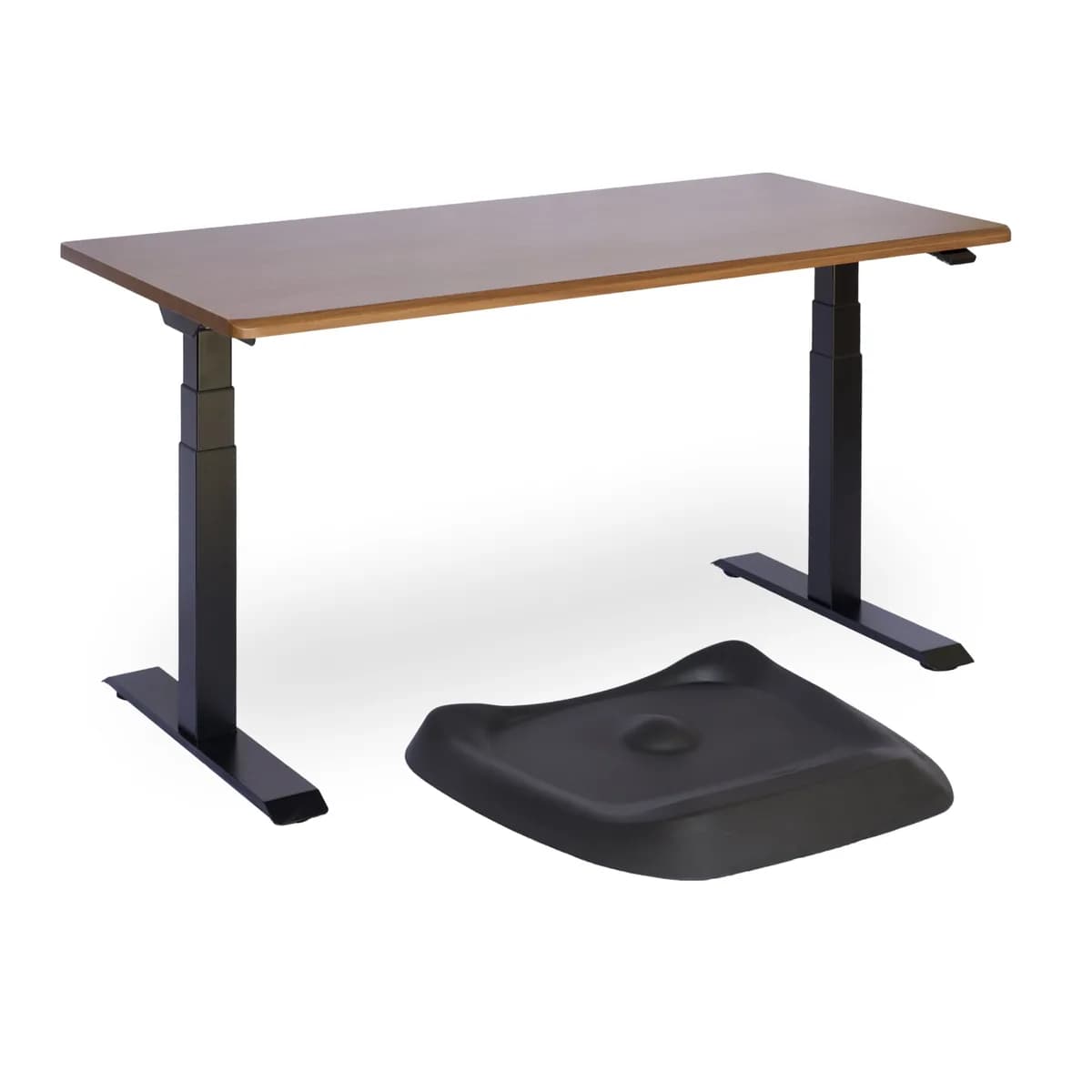
Ergodriven
Ergodriven Tempo Pro
The Tempo's argument is that the hard part of owning a standing desk is not the desk, it is remembering to use it. The controller is built into the surface, senses that someone is there, and moves the desk on a cadence rather than waiting to be asked — which addresses the single most common failure, a desk that spends a year at one height. The frame under it is a strong specification in its own right: three stages that put the 1-inch top at 23.8 to 49.4 inches, 360 lb, 40 dB, and sixteen years on the frame, motors, electronics and top together. The thing to weigh is whether automatic movement suits you. A desk that rises on a schedule is either the feature that finally makes the habit stick, or an interruption you disable in week two, and there is no way to know which you are until you live with it.
Fits 5′0″ to 6′8″ (est.)
Best for: Someone who has owned a standing desk before and left it at one height for a year.
Full spec sheet