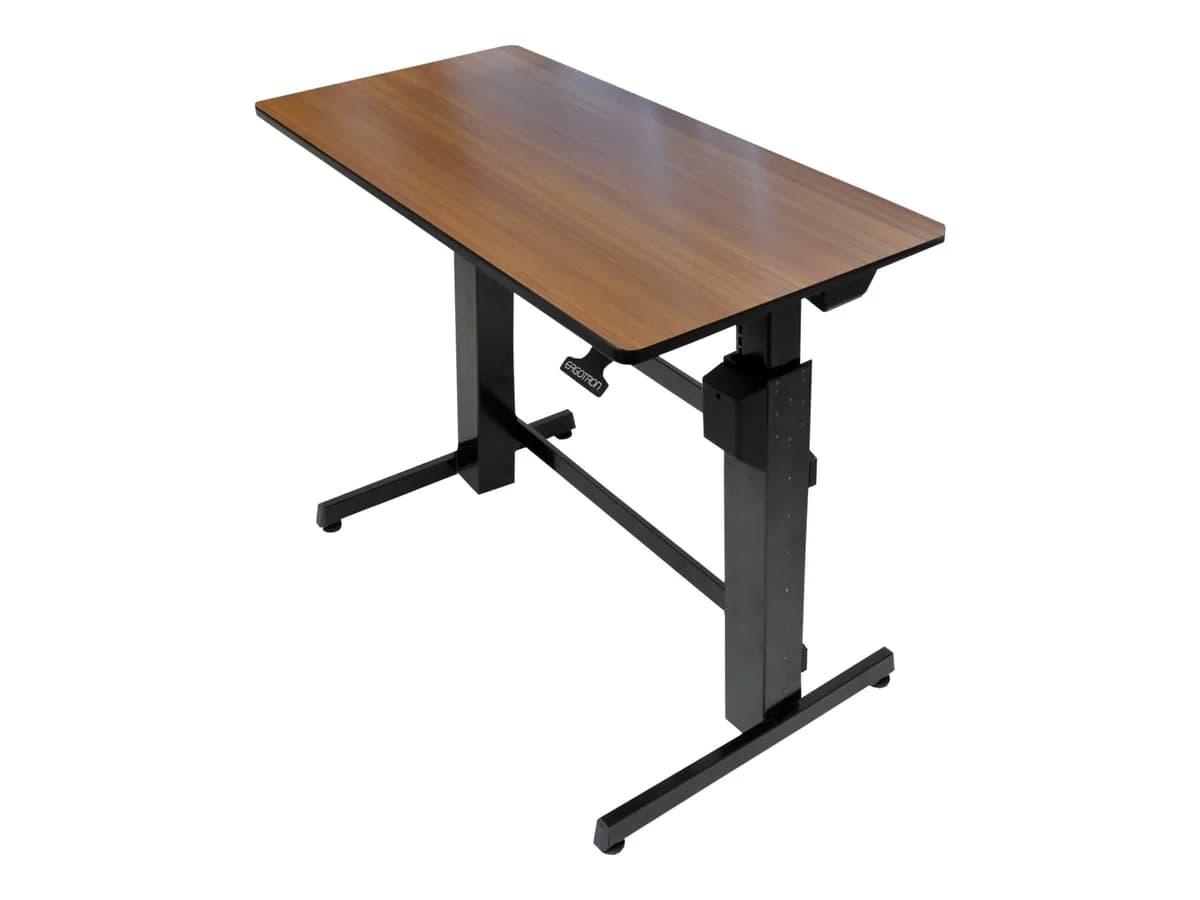
Ergotron WorkFit-D
Ergotron's Constant Force mechanism is a coiled spring tuned to the weight on the surface, so the desk rises and falls with one hand at whatever speed you move it, with no motor, no controller and no power lead. Set it up anywhere — a warehouse, a classroom, a room with no free outlet — and it never needs a firmware update or a replacement control box. For the twenty inches between 30.6 and 50.6 that is a genuinely excellent mechanism. The problem is where those twenty inches sit. A 30.6-inch minimum is above the height of an ordinary fixed desk, so by the seated-elbow rule this desk does not lower far enough for anyone under about 6 ft 4 in to sit at comfortably. Treat it as a standing desk that can drop to perching height, not as a sit-stand desk, and it makes sense. Expect it to fail you if you bought it to fix a too-high desk.
Who this desk fits
estimated, not measured
Reaching 30.6″ at the bottom and 50.6″ at the top, this desk can hit both a sitting and a standing elbow height for people roughly 6′5″ to 6′10″ tall.
How the height is quoted: Work-surface height with the top fitted. Note the 30.6-inch floor: this desk does not lower to a sitting height for most people, which is the defining fact about it.
Enter your height — 5'11", 71 or 180cm all work.
What ~$595 buys: Complete 47.6×23.5 desk with the constant-force lift and integrated brake; no power required.
Specifications
At a glance
Features
- Constant Force spring lift, no motor or power
- 20 in of one-handed travel with an integrated brake
- 165 lb rated capacity
- 47.6×23.5 in surface
- Silent, with nothing electronic to fail
In its favour
- Adjusts instantly with one hand, with no waiting for a motor
- No power lead, no control box, no firmware — it will work identically in fifteen years
- 165 lb on a spring mechanism is more than most people expect
- Completely silent
Against it
- The 30.6-inch minimum is higher than a standard fixed desk and too tall for almost anyone to sit at properly
- The spring has to be re-tensioned when you change the load on the surface
- One size only, and a shallow 23.5 inches at that
- No presets, because there is nothing to program
These points come from the published specification and the desk's design, not from owner reports — this model has not yet had enough owner discussion collected to draw on.
What owners say
Not enough owner discussion of the Ergotron WorkFit-D has been collected to write this section honestly yet. Rather than fill it with paraphrased marketing copy, it stays empty until there is something real to report. The specifications above come from the manufacturer's own documentation.
Ergotron WorkFit-D, head-to-head
Desks people look at alongside it
More from Ergotron →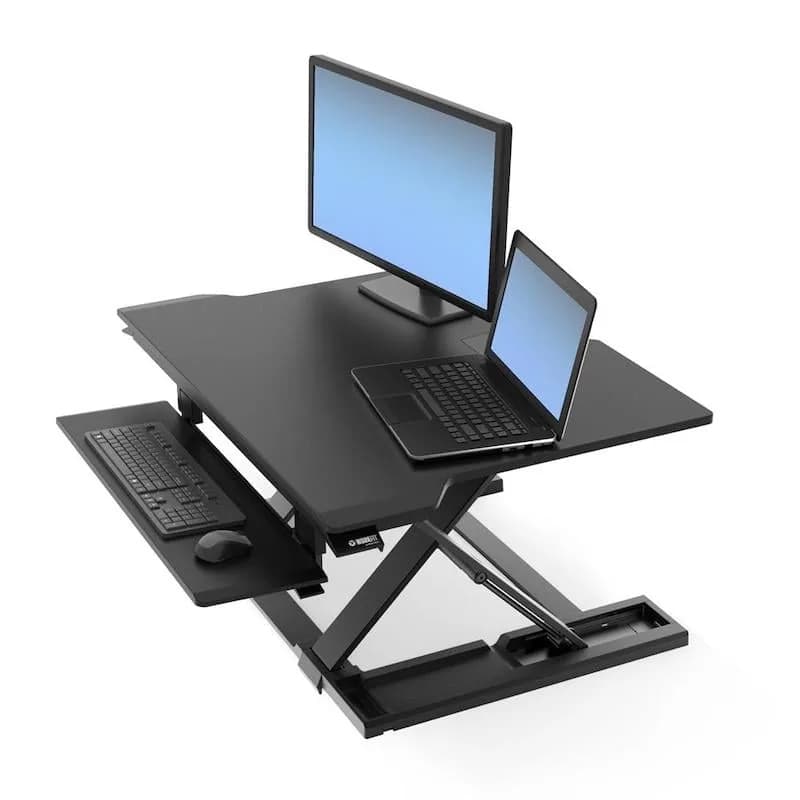
Ergotron
Ergotron WorkFit-TX
The TX is the converter that solves the two problems most risers have. It rests only two inches above the desk when lowered, so it does not permanently raise your keyboard when you are sitting — most converters add three or four inches you can never get rid of. And its keyboard deck hangs below the work surface and tilts back, keeping the monitor-to-keyboard relationship correct as the whole thing rises, where a single-shelf riser puts your keyboard and screen at the same height and forces you to look down at both. The X-shaped lift is spring-assisted, so it moves with one hand and needs no power. What it cannot do is lower your sitting height, because it sits on the desk you already have. The 40 lb rating covers a single monitor up to 30 inches and a laptop, not a dual-arm setup.
Reaches standing height for users up to 6′10″ (est.)
Best for: A fixed or rented desk where the sitting position must stay untouched.
Full spec sheetErgotron
Ergotron WorkFit-Z Mini
The Z Mini is the small one: 31 inches wide, 15.8 deep, 12.5 inches of straight-up lift on a Z-shaped frame with a hand-brake lever. Because the lift is vertical rather than arcing forward, it does not sweep across your desk as it rises, which matters when the desk is small enough that something is always in the way. The limits are honest and severe. Twelve and a half inches of lift is not enough to reach a comfortable standing height for most people from a normal 29-inch desk — by the standing-elbow rule its 42.5-inch ceiling suits someone around 5 ft 8 in and nobody taller — and 25 lb covers a laptop or one 24-inch monitor. It is the right product for a laptop user in a small space who wants to stand for twenty minutes at a time, and the wrong one for a permanent workstation.
Reaches standing height for users up to 5′9″ (est.)
Best for: A laptop user in a small space who wants to stand occasionally rather than all day.
Full spec sheet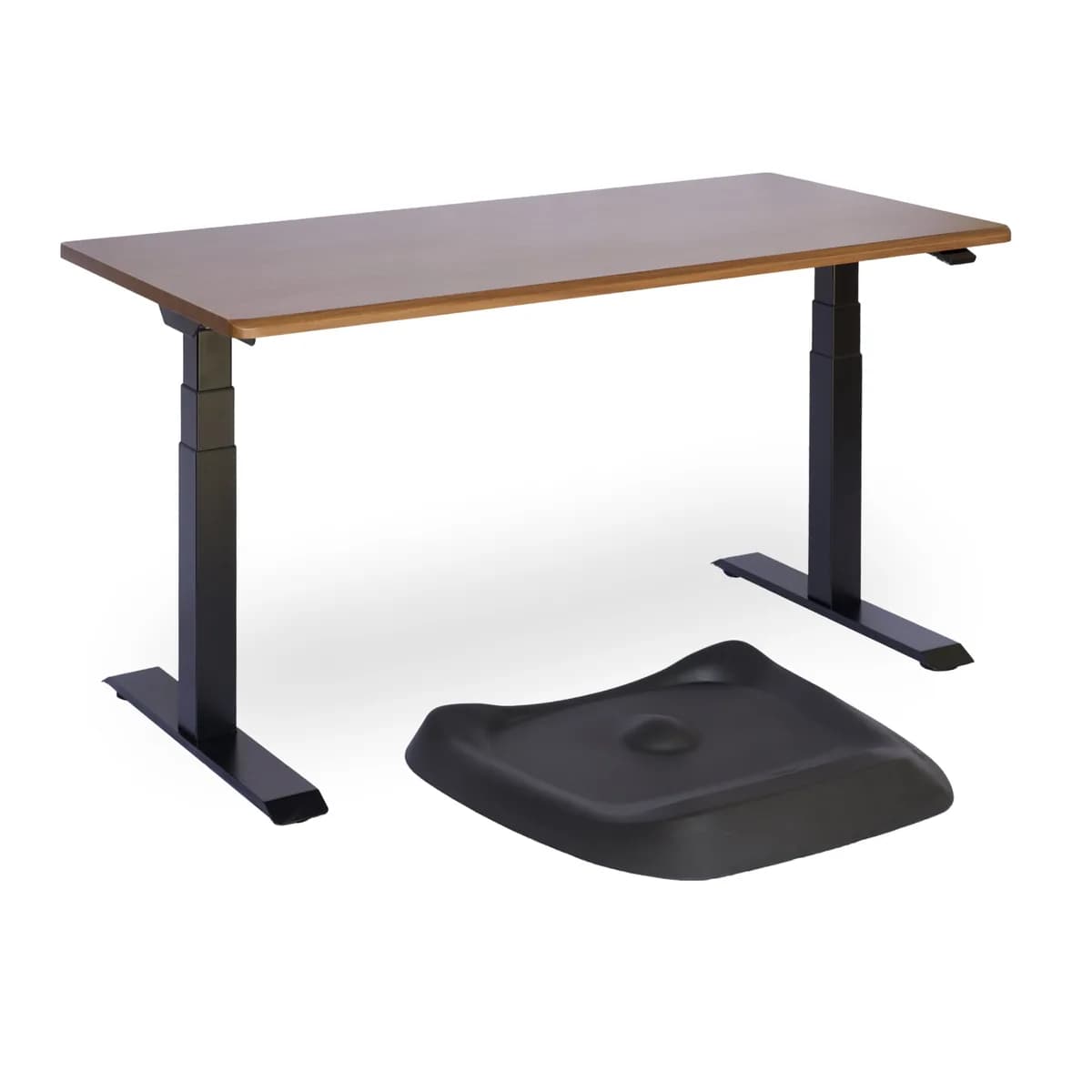
Ergodriven
Ergodriven Tempo Pro
The Tempo's argument is that the hard part of owning a standing desk is not the desk, it is remembering to use it. The controller is built into the surface, senses that someone is there, and moves the desk on a cadence rather than waiting to be asked — which addresses the single most common failure, a desk that spends a year at one height. The frame under it is a strong specification in its own right: three stages that put the 1-inch top at 23.8 to 49.4 inches, 360 lb, 40 dB, and sixteen years on the frame, motors, electronics and top together. The thing to weigh is whether automatic movement suits you. A desk that rises on a schedule is either the feature that finally makes the habit stick, or an interruption you disable in week two, and there is no way to know which you are until you live with it.
Fits 5′0″ to 6′8″ (est.)
Best for: Someone who has owned a standing desk before and left it at one height for a year.
Full spec sheet